
Skin Cycling GHK-Cu: The Recovery Night Ingredient
- 9 Mins to read
- Skincare Routines
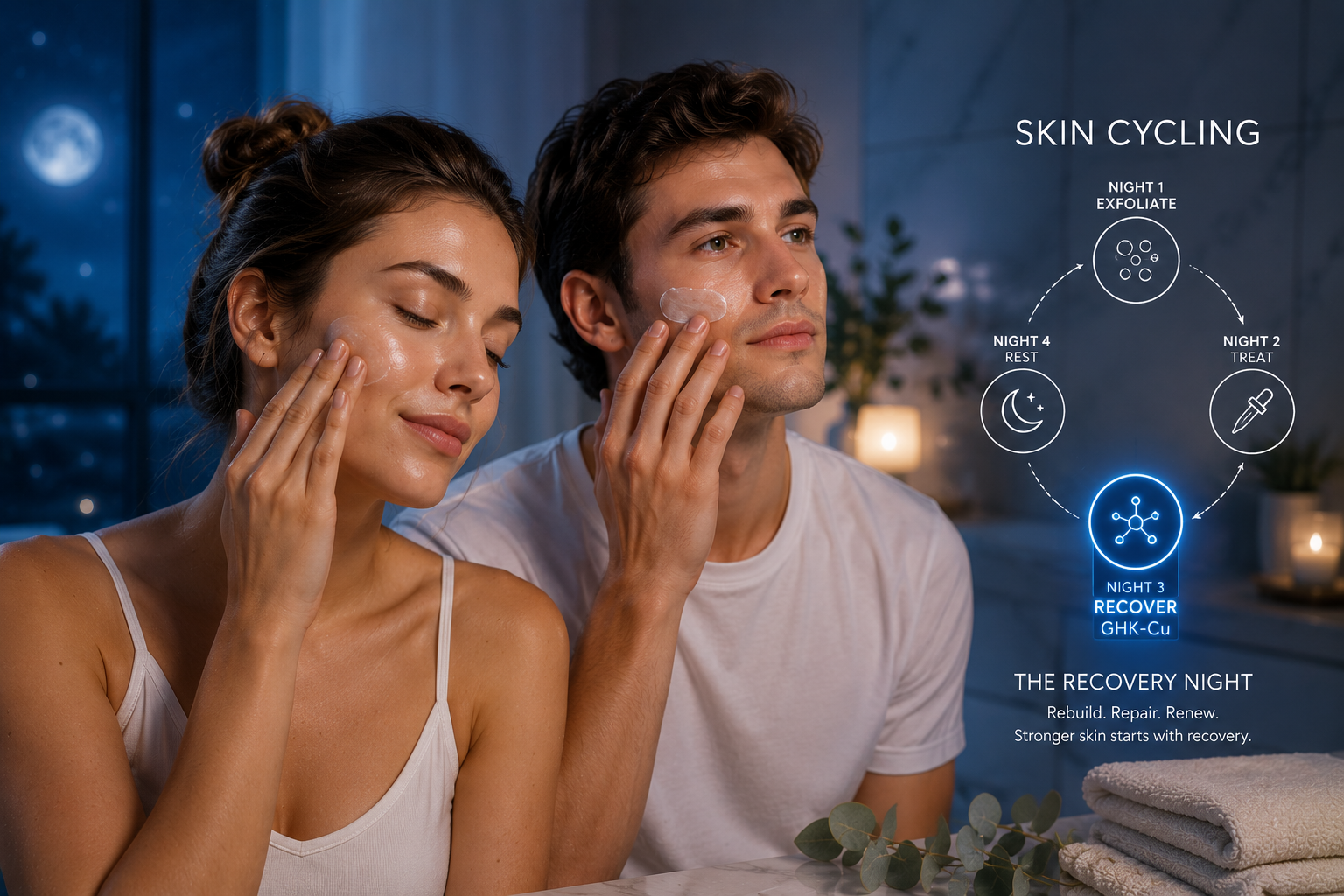
Skin cycling GHK-Cu is one of the most effective pairings in a modern evening routine — and once you understand why, it’s hard to unsee. Skin cycling exploded on TikTok in 2022 and hasn’t slowed down. In 2026 it’s firmly established as one of the most popular structured skincare frameworks — and for good reason. The core idea is simple: rather than piling multiple actives onto your skin every single night and wondering why it’s irritated, you rotate them strategically. Each night has a purpose, your skin gets time to recover, and you get better results with less reaction. GHK-Cu fits into this framework perfectly — particularly on recovery nights, where it genuinely earns its place.
What is Skin Cycling?
Skin cycling is a 4-night rotating evening routine, popularised by Dr Whitney Bowe, that alternates active ingredient nights with deliberate recovery nights. The original framework looks like this:
- Night 1: Exfoliation (AHA/BHA)
- Night 2: Retinol or retinoid
- Night 3: Recovery
- Night 4: Recovery
- Then repeat from Night 1
The two recovery nights are crucial — they’re not “do nothing” nights. They’re when the skin consolidates the work done by the actives, repairs barrier disruption caused by exfoliants and retinoids, and rebuilds its structural integrity. What you apply on recovery nights matters enormously — and this is exactly where GHK-Cu comes in.
Why Skin Cycling GHK-Cu Works So Well on Recovery Nights
Most people default to just a moisturiser on recovery nights. That’s not wrong, but it’s a missed opportunity. Recovery nights are actually when your skin is most actively repairing — fibroblasts are busy, the skin’s renewal machinery is running — and skin cycling GHK-Cu is designed to support precisely these processes. Research on copper peptide activity in skin fibroblasts, available via PubMed, consistently highlights its role in collagen signalling and barrier repair — making it a natural fit for the recovery phase. For a broader breakdown of how GHK-Cu compares to other actives, see our GHK-Cu vs Retinol guide.
It Supports What Retinol Started
Retinol on Night 2 accelerates cell turnover and signals collagen production. GHK-Cu on Night 3 supports the structural quality of what’s being produced — the collagen cross-linking, the fibroblast activity, the extracellular matrix renewal. The two ingredients are working on the same outcomes through complementary mechanisms, with GHK-Cu picking up where retinol’s stimulation leaves off.
It Helps Repair Barrier Disruption
Both AHAs and retinol can temporarily compromise the skin barrier — this is a known trade-off of their efficacy. GHK-Cu’s support for glycosaminoglycan production helps the barrier restore its moisture-retention capacity during recovery nights, meaning you’re not just waiting for the disruption to resolve passively but actively supporting the repair.
It Calms Post-Active Inflammation
Retinoids in particular can trigger low-grade inflammation as part of their mechanism. GHK-Cu’s anti-inflammatory properties — its influence on TNF-alpha and related signalling pathways — help create a calmer skin environment on recovery nights, potentially reducing the cumulative redness and sensitivity that some people experience with consistent retinol use.
The GHK-Cu Skin Cycling Routine
Here’s a practical adaptation of the classic skin cycling framework incorporating GHK-Cu on both recovery nights:
Night 1 — Exfoliation
Cleanser → AHA or BHA exfoliant (leave on for directed time or use leave-on formula) → Moisturiser
No GHK-Cu on exfoliation night — acids can interfere with the copper-peptide bond.
Night 2 — Retinol
Cleanser → Retinol or retinoid → Moisturiser (apply over retinol as a buffer if needed)
No GHK-Cu on retinol night — apply these at genuinely separate times to avoid interference.
Night 3 — Recovery with GHK-Cu
Cleanser → GHK-Cu solution (cotton pad, gentle dab) → Hyaluronic acid serum (optional) → Moisturiser
This is where GHK-Cu does its best work — supporting collagen, calming post-active inflammation, supporting barrier repair.
Night 4 — Recovery with GHK-Cu
Cleanser → GHK-Cu solution → Niacinamide serum (optional, fully compatible) → Rich moisturiser or facial oil
A second recovery night gives sensitive skin more time between actives. GHK-Cu again, with a more nourishing moisturiser.
Variations: Adapting the Cycle to Your Skin
For Sensitive or New-to-Retinol Skin
If your skin doesn’t yet tolerate retinol well, or you’re building up from a low concentration, consider extending the cycle to 5 or 6 nights — 1 exfoliation, 1 retinol, and 3–4 recovery nights with GHK-Cu. This gives the skin more time to benefit from the recovery phase before the next active night, and the anti-inflammatory properties of GHK-Cu may help reduce cumulative retinol sensitivity over time.
For Resilient Skin
If your skin is well-adapted to actives, you could tighten the cycle to 3 nights — exfoliation, retinol, recovery with GHK-Cu — and repeat. This means GHK-Cu every third night. However, for most people, the 4-night cycle with GHK-Cu on both recovery nights produces better sustained results without the cumulative irritation risk of faster cycling.
GHK-Cu-Only Cycling (No Retinol)
Skin cycling doesn’t require retinol. If you’re not using retinoids — perhaps because your skin is too sensitive, or you’re pregnant, or you simply choose not to — GHK-Cu can anchor its own simpler rotation:
- Night 1: Gentle AHA exfoliant
- Night 2: GHK-Cu
- Night 3: GHK-Cu
- Night 4: Recovery with rich moisturiser only
This is a gentler framework that still gives the skin structured active support without the adaptation challenges of retinol.
Morning Routine During Skin Cycling
Skin cycling is an evening practice — your morning routine stays consistent throughout the cycle:
- Gentle cleanser
- Antioxidant serum (vitamin C or niacinamide — applied in the morning to avoid GHK-Cu interaction)
- Moisturiser
- SPF 30 or higher — non-negotiable, especially when cycling exfoliants and retinol
Common Skin Cycling Mistakes to Avoid
- Applying GHK-Cu on acid or retinol nights: The interaction between GHK-Cu and strong acids can disrupt the copper-peptide bond. Keep them on separate nights as above.
- Skipping SPF in the morning: Exfoliants and retinol both increase photosensitivity. UV exposure on top of an active ingredient routine accelerates the very damage you’re trying to reverse.
- Rushing the cycle: More actives, more often is not better. The recovery nights are doing meaningful work — resist the temptation to shorten them.
- Using too high a retinol concentration too soon: Start low (0.025%) and build. GHK-Cu on recovery nights may help your skin adapt, but don’t push retinol strength faster than your skin is comfortable with.
How to Know if the Cycle is Working
After 6–8 weeks of consistent skin cycling with GHK-Cu on recovery nights, most people notice:
- Less redness and sensitivity than when using retinol every night
- Improved skin texture and evenness from the exfoliation and retinol nights
- Improved firmness and hydration from the GHK-Cu recovery nights
- A more sustainable routine that doesn’t require taking “breaks” from actives due to irritation
The skin cycling framework works precisely because it treats recovery as an active phase rather than dead time. With GHK-Cu on your recovery nights, those nights become as productive as the active ingredient nights — just through a different, gentler mechanism.
Ready to build your skin cycling routine?
Our GHK-Cu copper peptide is UK lab-verified to 99%+ purity, QR-authenticated with every order, and formulated specifically for topical cosmetic use. Free UK delivery. → Shop GHK-Cu at ghkcu.uk