GHK-Cu Skin Over 40: Why This Copper Peptide Belongs in Every Longevity Routine
- 9 Mins to read
- GHK-Cu Guide, skin longevity
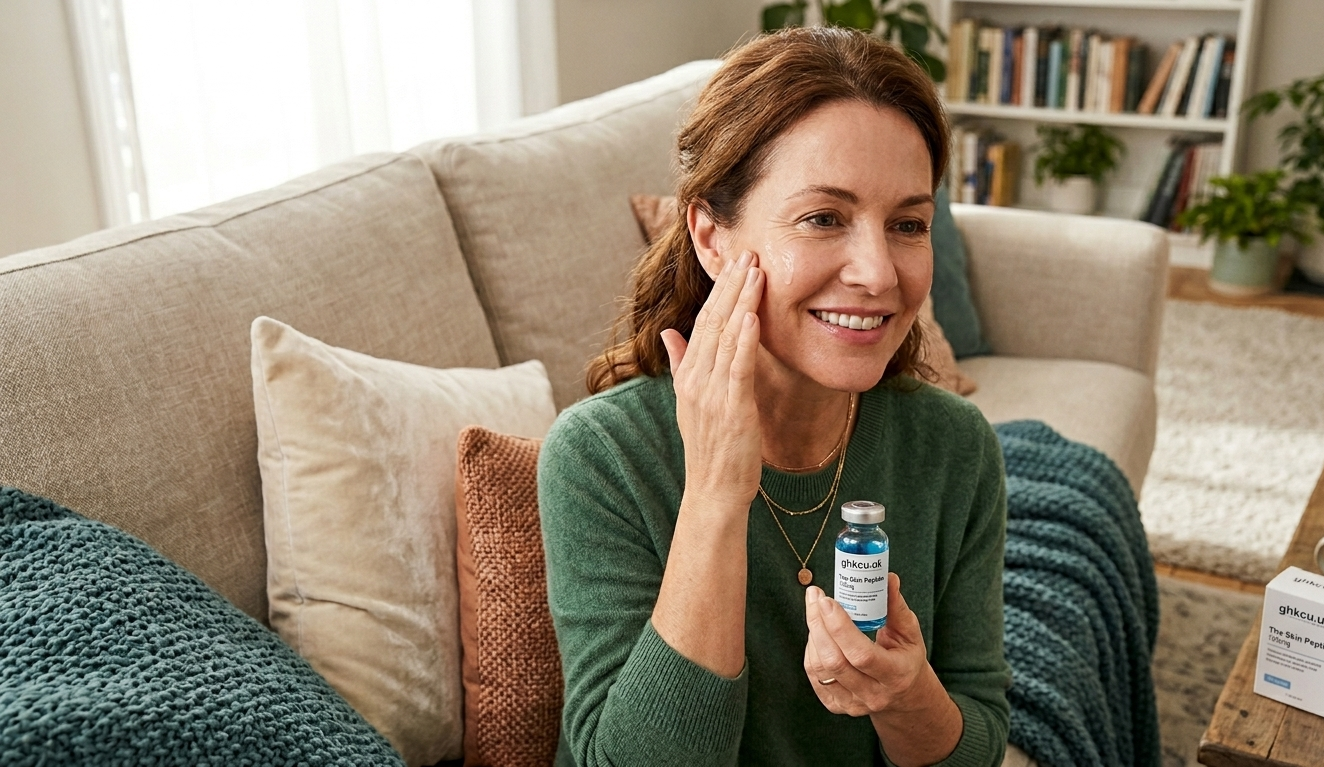
The science of GHK-Cu skin over 40 is better understood than ever — and the case for copper peptide as a foundational ingredient for skin longevity in your 40s and 50s is compelling.
If you’re researching GHK-Cu for skin over 40, you’re asking exactly the right question. Something shifts in the skin after 40 that most people feel before they can explain — a subtle change in texture, firmness and resilience that no single product seems to address the way it once did. The skin that bounced back effortlessly from a late night, a sun holiday, or a bout of stress now takes longer to recover. Lines that were once fine look deeper. The overall quality of the complexion — its density, its glow, its structural integrity — begins to feel different.
This isn’t imagination, and it isn’t inevitable in the way that many assume. There are specific, well-documented biological reasons why skin behaves differently after 40 — and equally specific ways to address them. GHK-Cu skin over 40 has become one of the most searched skincare topics in 2026 for good reason: the science behind copper peptide for mature skin is genuinely robust. Here’s what’s happening to your skin, and why GHK-Cu is so well-matched to it.
~1%
Collagen lost per year from mid-20s
60%
Decline in natural GHK-Cu levels by age 60
50+
Years of published GHK-Cu research
8 – 20
Weeks for measurable collagen improvements
What’s Actually Happening to Your Skin After 40
Skin ageing is not a single process — it’s the accumulation of several simultaneous biological shifts, each reinforcing the others. Understanding what’s happening is the first step to addressing it intelligently.
In Your 30s — The Slow Beginning
Collagen production has been declining by roughly 1–1.5% per year since the mid-twenties, but the cumulative loss isn’t yet highly visible. Cell turnover starts to slow. The first fine lines appear, particularly around the eyes and between the brows where facial movement is constant. Most people don’t notice significant change at this stage.
In Your 40s — The Acceleration Phase
This is when the cumulative decline in collagen density, elastin quality and skin cell renewal starts to become visibly apparent for most people. Two decades of 1% annual collagen loss adds up to a structural change. The dermal layer — the deeper layer that gives skin its firmness and cushioning — thins noticeably. Lines deepen, pores may appear more prominent as the surrounding skin loses its plumpness, and the overall complexion loses some of its intrinsic glow. For women, perimenopause and menopause during this decade bring an additional hormonal dimension: oestrogen supports collagen synthesis, and its decline accelerates skin thinning significantly.
Critically, the skin’s own repair mechanisms also slow. Wound healing takes longer. Post-inflammatory marks linger. The skin is less resilient to environmental stressors — UV, pollution, seasonal changes — than it was a decade earlier.
In Your 50s — Structural Change
Collagen loss compounds further, and changes in skin architecture become more pronounced. Fat redistribution changes the facial contour. The skin barrier — already compromised by decades of cumulative UV exposure and declining lipid production — becomes drier and more reactive. Many people find their skin is sensitive to products they once used without issue. The goal at this stage shifts from prevention to active structural support and barrier repair.
Why GHK-Cu Levels Decline — and Why It Matters Over 40
GHK-Cu (Copper Tripeptide-1) is a naturally occurring tripeptide — three amino acids: glycine, histidine and lysine — that binds to copper ions. It’s produced naturally by the human body and found in plasma, saliva and urine. Here’s the critical detail: natural GHK-Cu levels in plasma sit at approximately 200 ng/mL at age 20 and decline to around 80 ng/mL by age 60 — a drop of more than 60%. This decline closely tracks the well-documented reduction in the skin’s regenerative capacity over the same period.
This isn’t coincidental. GHK-Cu functions as a biological signalling molecule — it tells the skin’s own repair machinery to activate. When levels decline, that signalling weakens, and the skin’s ability to produce, organise and maintain its structural proteins deteriorates accordingly. Replenishing GHK-Cu topically doesn’t add collagen from the outside — it signals the skin’s own fibroblasts to produce and organise their own collagen more effectively.
GHK-Cu Skin Over 40: Why It’s Particularly Well-Matched to Mature Skin
There are many cosmetic actives that address one aspect of skin ageing. GHK-Cu’s appeal for skin longevity specifically is that it addresses several of the key biological shifts of the 40s and 50s simultaneously:
- Supporting Collagen and Elastin at the Structural Level
GHK-Cu delivers bioavailable copper to the cells that need it for collagen synthesis and organisation. Copper is an essential co-factor for lysyl oxidase — the enzyme responsible for properly cross-linking collagen fibres after they’re produced. Without adequate copper, newly formed collagen is structurally weaker. GHK-Cu doesn’t just stimulate collagen production; it supports the quality of the collagen being made — which matters more at 45 than it does at 25, when the skin’s collagen remodelling is less efficient. - Barrier Repair — Critical for GHK-Cu Skin Over 40 Routines
The skin barrier becomes increasingly compromised with age. GHK-Cu supports the production of glycosaminoglycans — the complex hydrating molecules (including hyaluronic acid) that maintain the skin’s structural moisture from within. Research published in the Journal of Aging Science highlights GHK-Cu’s role in modulating genes related to skin barrier maintenance and extracellular matrix organisation. For skin that has become drier and more reactive in the 40s and 50s, this is directly relevant. - Anti-Inflammatory Properties
Chronic low-grade inflammation — sometimes called “inflammaging” in longevity research — is increasingly understood as a central driver of accelerated skin ageing. UV damage, environmental pollutants and the skin’s own declining repair efficiency all contribute to this background inflammatory state. GHK-Cu has demonstrated anti-inflammatory effects in studies examining its influence on pro-inflammatory cytokines including TNF-alpha and IL-6. For skin in the 40s and 50s, a calmer inflammatory environment supports better structural maintenance. - Antioxidant Support
Decades of sun exposure generate cumulative oxidative stress — free radical damage to skin cells that breaks down collagen, disrupts elastin and drives the uneven pigmentation many people notice in their 40s. GHK-Cu activates the body’s own antioxidant defence pathways, including superoxide dismutase, helping to neutralise this ongoing oxidative damage. This is not a replacement for daily SPF — nothing is — but it’s a meaningful additional layer of antioxidant support at the cellular level. - Tolerability — a Practical Advantage
Skin in the 40s and 50s is often more reactive than it was previously, which creates a problem with many of the most effective cosmetic actives. Retinoids, acids and high-concentration vitamin C can all cause irritation in skin that is already compromised at the barrier level. GHK-Cu is one of the most well-tolerated cosmetic actives available — because it is a peptide that the body naturally produces, it sits well with even sensitive or reactive skin. This makes it accessible at a stage of life when many people are finding their previous active ingredients harder to use.
What the Research Shows for Mature Skin Specifically
Several published studies have specifically examined GHK-Cu’s effects on photodamaged and mature skin:
- A controlled study of women with mild to advanced sun-related skin damage found that GHK-Cu topical application over 12 weeks produced measurable improvements in skin density, thickness and fine line depth — outperforming both a placebo and a vitamin K control formulation on multiple metrics.
- A pilot study examining older participants with thinning skin found improvements in collagen density, skin thickness and elasticity after consistent copper peptide use — directly addressing the structural decline that characterises skin in the 40s and beyond.
- Gene expression research — which examines which genes a compound activates — has found that GHK-Cu influences the expression of genes involved in collagen synthesis, extracellular matrix maintenance, antioxidant defence and anti-inflammatory pathways simultaneously. The breadth of this influence across multiple aspects of skin ageing makes it particularly relevant as a longevity-focused ingredient.
How to Use GHK-Cu as a Skin Longevity Ingredient
For skin in the 40s and 50s, GHK-Cu works best as a consistent daily ingredient rather than an occasional addition. The structural improvements it supports — collagen density, barrier integrity, inflammatory calm — are cumulative and develop gradually over weeks and months of use.
| Routine Slot | What to Apply | Notes |
| Morning cleanse | Gentle, barrier-supporting cleanser | Avoid stripping formulas — barrier health is priority |
| Morning serum | Niacinamide or hyaluronic acid | Both fully compatible with GHK-Cu |
| Morning active | GHK-Cu solution (optional AM use) | Skip if using vitamin C in AM — use PM instead |
| Morning SPF | SPF 30–50, broad spectrum | Non-negotiable — daily UV is the biggest collagen destroyer |
| Evening cleanse | Gentle double cleanse if wearing SPF | – |
| Evening active | GHK-Cu solution | Apply to clean, dry skin before moisturiser |
| Evening moisture | Rich moisturiser or facial oil | Skin in 40s+ benefits from a more occlusive evening moisturiser |
| 2–3x per week | Low-strength retinol (0.025–0.05%) | Alternate evenings with GHK-Cu — don’t combine in same step |
The menopause consideration: For women in perimenopause or post-menopause, the decline in oestrogen significantly accelerates collagen loss — some studies suggest up to 30% of skin collagen may be lost in the first 5 years post-menopause. GHK-Cu’s direct support for collagen synthesis is particularly relevant at this stage. It does not replace hormonal considerations (discuss these with your GP), but it addresses the skin-structural aspect of this transition directly.
Realistic Expectations: What You Can and Can’t Achieve
Being honest about expectations matters. GHK-Cu is not a reversal of ageing — no topical cosmetic is. What it can realistically support, with consistent daily use over 8–12+ weeks:
- Improved skin density and firmness — measurable in published studies at 12 weeks; perceptible as a subtle but real improvement in how the skin feels and sits
- Reduced fine line depth — not erasure, but meaningful softening consistent with improved collagen organisation
- Better skin texture — smoother surface as collagen remodelling supports more even skin architecture
- Improved hydration and barrier function — via glycosaminoglycan support; skin that feels less dry and reactive
- A calmer, more even complexion — via anti-inflammatory and antioxidant activity; less persistent redness or uneven tone
- What it won’t do: eliminate deep structural volume loss, address significant sun damage without professional treatment, or replace SPF as the single most important daily habit for skin longevity at any age.
GHK-Cu vs Other Anti-Ageing Ingredients in Your 40s
| Ingredient | Best For in 40s+ | Tolerability | Pairs With GHK-Cu? |
| GHK-Cu | Collagen quality, barrier, inflammation, antioxidant | Excellent | – |
| Retinol | Cell turnover, texture, pigmentation | Can irritate mature skin — start very low | ✅ Alternate evenings |
| Niacinamide | Barrier support, pore appearance, tone evening | Excellent | ✅ Fully compatible |
| Hyaluronic Acid | Surface and dermal hydration | Excellent | ✅ Fully compatible |
| Vitamin C | Brightening, antioxidant, pigmentation | Good — use L-AA with caution on sensitive skin | ⚠️ Use AM; GHK-Cu PM |
| Peptide complexes (Matrixyl) | Collagen signalling — complementary mechanism | Excellent | ✅ Compatible |
| SPF | Preventing further collagen breakdown — essential | Excellent | ✅ Every morning |
Building a Longevity Routine That Actually Works
The most common mistake in skincare after 40 is overcomplication — piling on multiple high-strength actives in the hope that more is more. The research doesn’t support this approach, and mature skin is often less tolerant of active overload than younger skin. A simpler, more consistent routine built around a few well-chosen ingredients outperforms a complex, irregular one every time.
The foundation for skin longevity in the 40s and 50s is straightforward:
- Daily SPF — without this, everything else is fighting an uphill battle
- GHK-Cu — daily, as a structural and barrier support ingredient
- A good barrier moisturiser — richer than you may have used in your 30s
- Low-strength retinol — introduced slowly, on alternating evenings, for cell turnover
- Niacinamide or hyaluronic acid — as a compatible supporting layer
Consistency over months matters far more than the specific concentration of any single ingredient. GHK-Cu works through genuine biological processes that take time — the studies that show meaningful results run for 8–12 weeks, not days.
For external cosmetic use only. GHK-Cu from ghkcu.uk is a cosmetic ingredient for topical application. If you are pregnant, breastfeeding or have any health condition, consult your GP before adding new skincare actives. Patch test recommended before first use.
Why Purity Matters More in a Longevity Routine
When you’re committing to a daily ingredient as part of a long-term skin longevity strategy, knowing exactly what you’re applying is not optional — it’s foundational. GHK-Cu is a sensitive compound whose characteristic copper-binding structure is essential to its function. Impure or degraded product doesn’t just underperform — it may not perform at all.
Every vial of GHK-Cu from ghkcu.uk is independently HPLC-tested by a UK laboratory to verify 99%+ purity, and comes with a unique QR code linking to the Certificate of Analysis for your specific batch. You can verify your results before opening the vial. This level of transparency isn’t common in the UK copper peptide market — it’s the standard we hold ourselves to because it’s what a serious skincare approach deserves.
Start Your GHK-Cu Longevity Routine
Pure GHK-Cu copper peptide, independently lab-tested to 99%+ purity. QR-verified Certificate of Analysis with every order. Free UK delivery. The foundational ingredient for serious skin longevity — from a UK supplier who publishes the evidence.