GHK-Cu for Skin: Benefits, Science & How to Use It
- 9 Mins to read
- How-To Guides, Skincare Science
If you follow skincare science at all, you’ve almost certainly come across GHK-Cu. It’s on TikTok, in beauty forums, and increasingly in serious skincare routines. But with so many ingredients claiming transformative results, it’s worth asking: what does the evidence actually say about GHK-Cu for skin? And more practically — how do you use it properly?
Why Skin Enthusiasts Are Turning to GHK-Cu
Skin ageing isn’t a single process — it’s the cumulative result of declining collagen production, reduced hyaluronic acid levels, slower cell turnover, increased oxidative stress and diminishing structural protein quality. Most skincare ingredients address one of these factors. Retinoids stimulate cell turnover. Hyaluronic acid adds surface hydration. Vitamin C supports collagen synthesis. GHK-Cu’s appeal is that it appears to work across several of these pathways simultaneously.
As a naturally occurring peptide in the human body — one whose levels decline significantly from our mid-twenties onwards — GHK-Cu occupies an interesting position: it’s not introducing a foreign compound to the skin, but replenishing something the body already recognises and knows how to use.
The Skin Benefits of GHK-Cu: What the Science Shows
1. Supporting Collagen & Elastin Production
Collagen is the scaffolding of the skin, responsible for its firmness and structure. Elastin allows it to spring back after movement. Both decline steadily with age — collagen production drops by roughly 1–1.5% per year from the mid-twenties — and this decline is central to the formation of fine lines, sagging and loss of definition.
GHK-Cu supports collagen and elastin synthesis by delivering bioavailable copper to the cells that produce these proteins. Copper acts as a co-factor for lysyl oxidase, an enzyme essential for properly cross-linking newly produced collagen fibres. Without adequate copper, collagen forms but lacks structural integrity. Studies examining GHK-Cu applied topically have documented improvements in collagen density in treated skin compared with untreated controls, alongside improvements in skin thickness and firmness.
2. Improving Skin Firmness and Texture
Multiple studies involving women using GHK-Cu topical preparations over 8–12 weeks have reported measurable improvements in skin firmness, elasticity and surface texture. In one frequently cited trial involving over 70 participants, copper peptide cream demonstrated improvements in skin density and a reduction in fine line depth after 12 weeks of twice-daily application. A later controlled study found GHK-Cu outperformed a vitamin K formulation for reducing the appearance of wrinkles around the eye area over the same period.
What distinguishes these results from temporary cosmetic effects — like the plumping produced by hyaluronic acid serums — is that improvements in collagen density represent actual tissue changes rather than surface-level hydration.
3. Reducing the Visible Signs of Photoageing
Sun exposure is the single biggest external contributor to visible skin ageing. UV radiation generates free radicals that damage skin cells at a molecular level, breaking down collagen, disrupting elastin and causing uneven pigmentation. GHK-Cu addresses this through two mechanisms: its antioxidant activity helps neutralise these free radicals, while its support for collagen synthesis helps the skin recover structural integrity over time.
Studies examining participants with mild to advanced photoageing (sun-related skin damage) have reported visible improvements including reduced laxity, improved skin clarity, and a more even skin tone after consistent copper peptide use.
4. Supporting the Skin Barrier
A functioning skin barrier is the foundation of healthy skin. It keeps moisture locked in and environmental irritants out. When the barrier is compromised — through over-exfoliation, harsh cleansers, or environmental factors — skin becomes dry, reactive and more prone to sensitivity. GHK-Cu has been shown to support the production of glycosaminoglycans, the molecules that help maintain the skin’s structural hydration and barrier integrity.
5. Calming Visible Redness and Sensitivity
Chronic low-grade inflammation is a key driver of accelerated skin ageing and can contribute to persistent redness, uneven tone and reactive skin. GHK-Cu has demonstrated anti-inflammatory properties in studies examining its effect on pro-inflammatory signalling molecules, including TNF-alpha. For those with sensitive or reactive skin, these properties make it an interesting addition to a calming skincare routine — though a patch test is always recommended before broad application.
How Does GHK-Cu Compare with Other Anti-Ageing Ingredients?
| Ingredient | Primary Action | Collagen Effect | |
|---|---|---|---|
| GHK-Cu | Multi-pathway signalling | Stimulates production & quality | — |
| Retinol | Accelerates cell turnover | Indirect stimulation | Use at separate times |
| Vitamin C | Antioxidant, collagen co-factor | Indirect stimulation | Not in same application |
| Hyaluronic Acid | Surface hydration | No direct effect | Yes, compatible |
| Niacinamide | Barrier support, brightening | Indirect support | Yes, compatible |
| Peptides (Matrixyl etc.) | Collagen signalling | Single-pathway stimulation | Yes, compatible |
What Realistic Results Look Like, and When to Expect Them
GHK-Cu works through genuine tissue processes, which means results develop gradually rather than overnight. Setting realistic expectations is important:
- Weeks 1–2: Improved skin hydration and a possible reduction in surface redness are usually the first changes people notice, consistent with GHK-Cu’s effect on glycosaminoglycans and its anti-inflammatory properties.
- Weeks 3–6: Skin texture typically begins to improve as early collagen remodelling takes effect. Fine lines may begin to look softer.
- Months 2–3: More visible improvements in skin density, firmness and overall quality — these are the changes backed by the majority of published studies.
- Month 3+: Results tend to stabilise. Unlike temporary surface treatments, improvements from GHK-Cu reflect genuine structural changes, which means they persist for some time after use — though continued use helps maintain peak results.
How to Build GHK-Cu Into Your Skincare Routine
The most important compatibility consideration is keeping GHK-Cu away from strongly acidic ingredients in the same application. Vitamin C serums (particularly those using L-ascorbic acid), AHAs and BHAs can destabilise the copper-peptide complex and reduce its effectiveness. A practical approach:
- Morning: Niacinamide, hyaluronic acid, SPF — GHK-Cu can be used here if you’re not using vitamin C
- Evening: An excellent time for GHK-Cu, applied after cleansing and before a moisturiser
- If using retinol or acids in the evening, consider alternating nights rather than layering
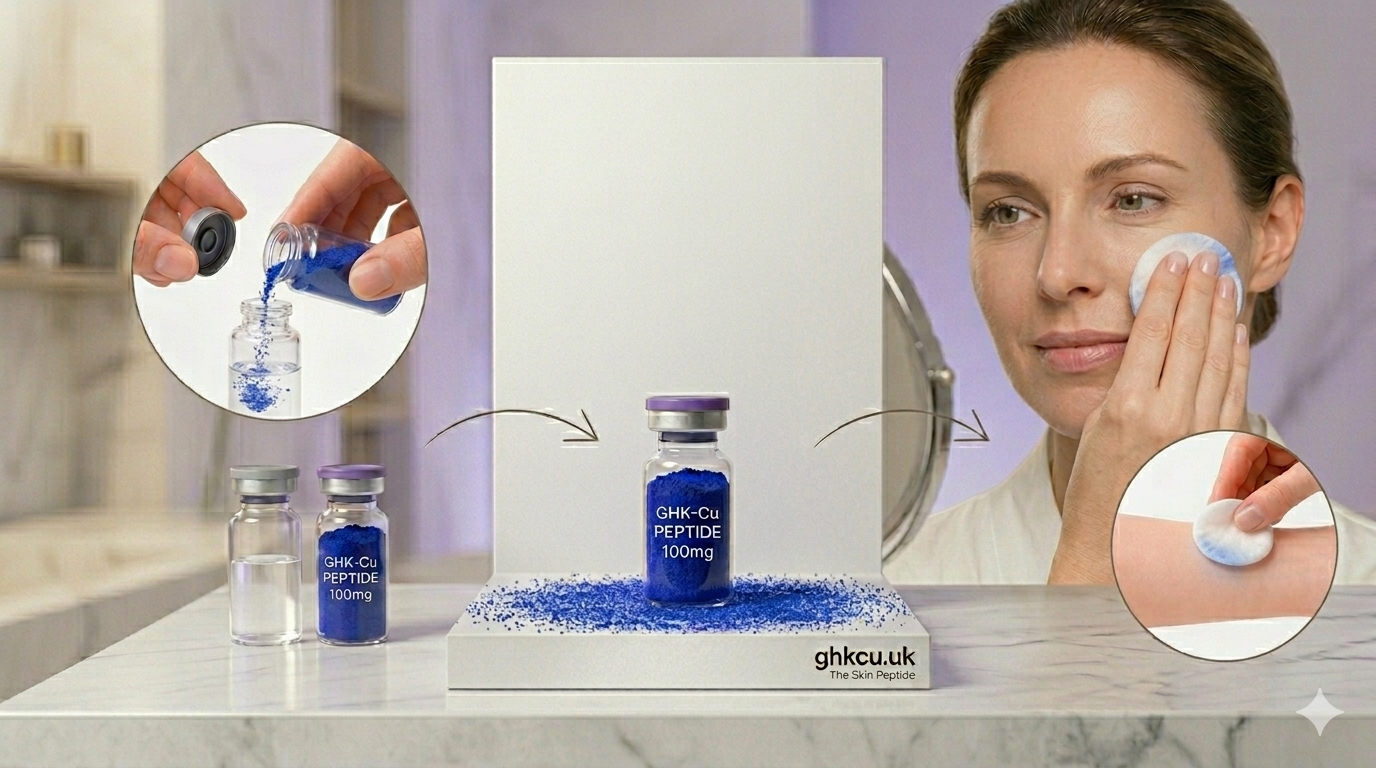
Application reminder: GHK-Cu from ghkcu.uk is supplied as a powder for topical cosmetic use. Reconstitute fully before applying, and always apply to clean, dry skin. For external use only.
Who is GHK-Cu For?
GHK-Cu is suited to most skin types and is particularly popular among those focused on:
- Visible signs of ageing — fine lines, loss of firmness, skin thickness
- Post-sun skin recovery and uneven tone
- Improving overall skin texture and quality
- Sensitive or reactive skin (thanks to its anti-inflammatory properties)
- Those building a science-backed routine and looking to go beyond basic moisturisation
Shop GHK-Cu at ghkcu.uk
— Lab-verified to 99%+ purity, QR-authenticated with every order, free UK delivery. → View our GHK-Cu copper peptide