
GHK-Cu for Acne Scars: Can Copper Peptide Help?
- 9 Mins to read
- Skincare Science
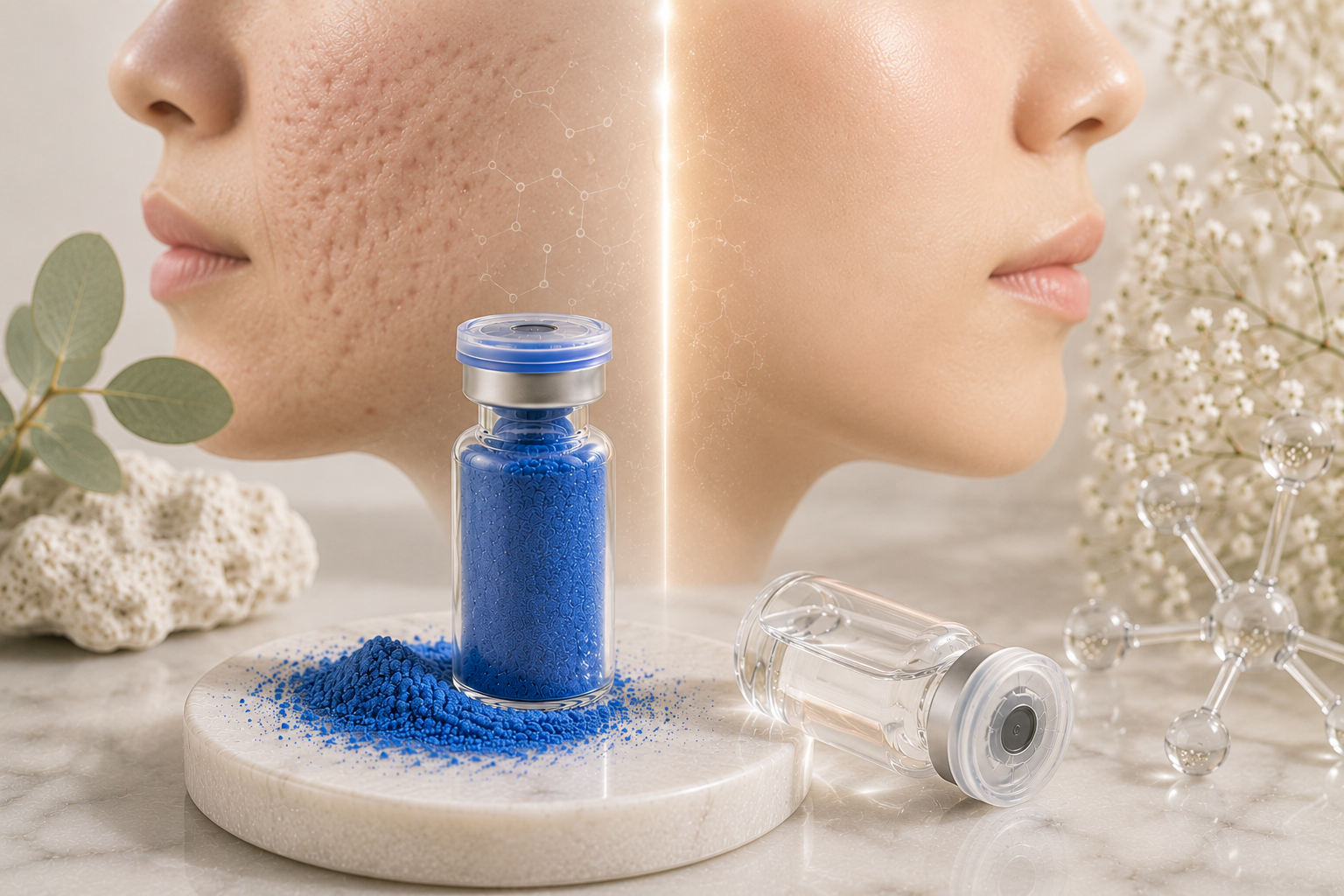
GHK-Cu for acne scars is a topic that comes up constantly — and for good reason. Post-acne marks are one of the most common skincare concerns in the UK, and one of the most frustrating. The breakout itself resolves, but the evidence it leaves behind can linger for months or years: red or brown marks, uneven texture, shallow depressions, and a complexion that looks anything but even. If you’ve been researching whether GHK-Cu for acne scars is worth trying, here’s what the science suggests and how to approach it realistically.
Understanding the Different Types of Post-Acne Marks
Not all post-acne marks are the same, and it’s worth being clear about the distinctions — because different types respond to different approaches:
- Post-inflammatory hyperpigmentation (PIH): Flat brown or pink marks left after a spot heals. These are changes in pigment, not structure, and typically fade naturally over 3–12 months. Topical actives can accelerate this.
- Post-inflammatory erythema (PIE): Flat red or pink marks, more common in lighter skin tones. Caused by dilated blood vessels left after inflammation. Also fades over time but can be stubborn.
- Atrophic scarring: Shallow depressions or pits left when tissue is lost during healing — icepick, rolling and boxcar scars fall into this category. More structural and harder to address with topical ingredients alone.
- Textural changes: Roughness or unevenness left after repeated breakouts, where skin texture has been disrupted even without visible scarring.
GHK-Cu is most relevant to the first three categories — its anti-inflammatory and skin-renewal properties are most applicable to PIH, PIE and mild textural changes. For deep atrophic scarring, professional treatments such as microneedling or resurfacing remain the most established approach, though GHK-Cu for acne scars can play a meaningful supporting role in the recovery phase. You can also read how it compares to other actives in our GHK-Cu vs Retinol guide.
How GHK-Cu for Acne Scars May Support Post-Acne Skin
- Anti-Inflammatory Properties
One of GHK-Cu’s most relevant properties for post-acne skin is its ability to support anti-inflammatory pathways. Acne scarring occurs precisely because the inflammatory response to a breakout is excessive or prolonged — the more inflammation, the more tissue disruption, and the more likely a mark or scar is to form. GHK-Cu has been shown to influence pro-inflammatory signalling molecules including TNF-alpha, helping to calm the skin environment and potentially reduce the intensity of post-breakout inflammation.
Applied consistently after a breakout has resolved, this anti-inflammatory activity may help support a calmer healing environment. This is one of the key reasons people explore GHK-Cu for acne scars — particularly for the red, vascular marks (PIE) that can linger long after active breakouts have cleared. Research published on PubMed supports GHK-Cu’s role in modulating inflammatory signalling pathways relevant to post-wound skin recovery.
2. Supporting Skin Renewal
GHK-Cu’s support for collagen synthesis and skin cell activity is directly relevant to the process of scar maturation. After any skin wound — including the micro-wounds caused by inflammatory acne — the skin goes through a remodelling phase in which new collagen is deposited to replace damaged tissue. The quality and organisation of this new collagen determines how smooth or disrupted the final surface will be.
By supporting fibroblast activity and collagen cross-linking via its copper delivery mechanism, GHK-Cu may help support a more organised collagen remodelling process — which is why it’s of interest to those dealing with mild atrophic scarring and textural changes.
3. Supporting Skin Barrier Function
Post-acne skin is often compromised at the barrier level — repeated breakouts, topical treatments (particularly those with acids or retinoids) and the inflammation process itself can all disrupt the skin’s protective outer layer. GHK-Cu’s support for glycosaminoglycan production helps the barrier retain moisture and maintain integrity, creating a better environment for the skin’s natural recovery processes to operate.
What GHK-Cu Won’t Do
It’s important to be honest here. GHK-Cu for acne scars is a cosmetic approach — it is not a treatment for acne itself, and it cannot reverse deep atrophic scarring. For ice-pick or deep boxcar scars, the structural loss of tissue requires professional intervention. Topical actives — including the best-researched ones — can support the skin’s environment and recovery, but they cannot rebuild lost tissue volume. The British Association of Dermatologists recommends consulting a dermatologist for moderate-to-severe scarring.
Realistic expectations are essential. GHK-Cu can support a calmer, more even complexion and a better skin renewal environment. It can help PIH and PIE marks fade more efficiently. For mild textural changes, consistent use may produce visible improvements in surface evenness over several months. What it cannot do is eliminate deep structural scarring.
Building a Routine for Post-Acne Marks
A practical cosmetic routine that incorporates GHK-Cu for post-acne skin:
Morning
- Gentle, non-stripping cleanser
- Niacinamide serum (supports barrier, helps with PIH)
- GHK-Cu solution — apply to affected areas with a cotton pad (compatible with niacinamide)
- Lightweight moisturiser
- SPF 30 or higher — essential, as UV exposure worsens PIH significantly
Evening
- Double cleanse if wearing SPF or makeup
- GHK-Cu solution or, on alternating evenings, a low-strength retinoid (retinol 0.025–0.05%)
- Moisturiser
Key compatibility note: If you’re using AHAs (glycolic or lactic acid) to address texture and PIH, keep these separate from GHK-Cu. Use acids on alternate evenings to retinol, and GHK-Cu on the remaining nights. This is the skin cycling approach — see our skin cycling guide for the full breakdown.
How Long Before You See Results?
Post-acne marks, by their nature, take time to resolve regardless of what you apply. GHK-Cu can support and potentially accelerate the process, but it won’t deliver overnight results. Realistic timelines:
- PIE (red marks): 8–16 weeks of consistent use alongside good SPF compliance
- PIH (brown marks): 12–24 weeks — particularly in deeper skin tones where pigment changes are more persistent
- Textural improvement: 12–20 weeks for meaningful change
Consistency matters far more than intensity. A steady daily routine over several months will produce better results than sporadic applications. Sun protection is non-negotiable — UV exposure can reactivate PIH and significantly slow resolution regardless of how good your active skincare routine is.
GHK-Cu vs Other Post-Acne Scar Ingredients
| Ingredient | Best For | Works With GHK-Cu? |
| GHK-Cu | Barrier support, collagen renewal, anti-inflammation | – |
| Niacinamide | PIH, pore appearance, barrier | ✅ Yes — fully compatible |
| Retinol | Cell turnover, texture, PIH | ⚠️ Alternate evenings |
| AHAs (glycolic, lactic) | Surface texture, PIH | ⚠️ Use on separate evenings |
| Vitamin C | PIH brightening, antioxidant | ⚠️ Use at different times |
| Azelaic acid | PIH, PIE, redness | ✅ Generally compatible |
| SPF | Protecting all of the above | ✅ Essential — use every morning |
Shop GHK-Cu at ghkcu.uk
— Pure copper peptide, HPLC-tested to 99%+ purity with QR-verified Certificate of Analysis. Free UK delivery on every order. → View our GHK-Cu copper peptide