GHK-Cu Menopause Skin: 5 Proven Ways to Support Collagen
- 9 Mins to read
- Skincare Science
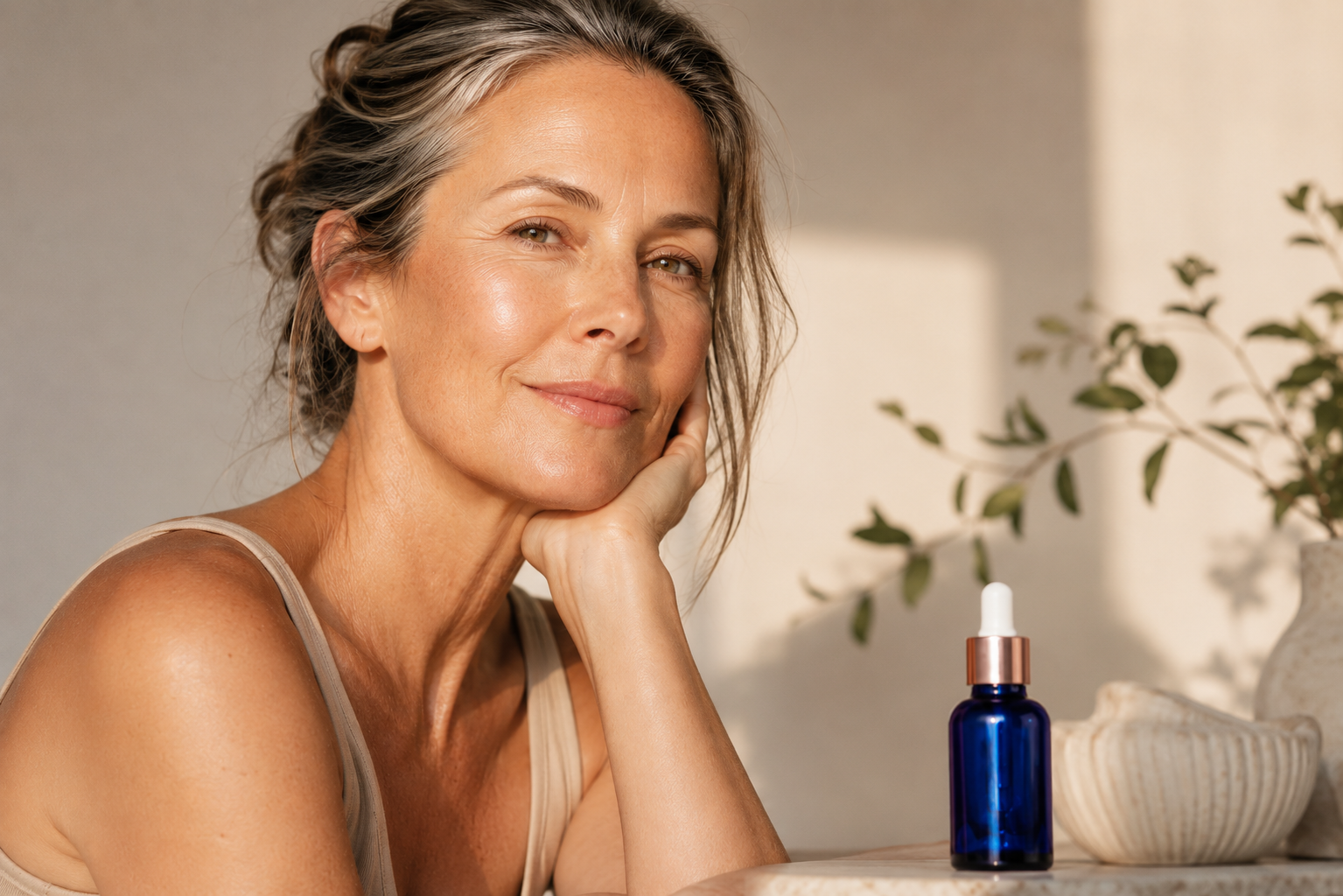
GHK-Cu menopause skin support has become a bigger topic as more women look for science-backed ways to counter the collagen loss that comes with hormonal change. Estrogen decline during menopause can accelerate thinning, dryness, and loss of elasticity — but this copper peptide offers a targeted way to help rebuild what’s being lost. Here’s how it works, and what results you can realistically expect.
If your skin has changed significantly in the last few years and you’re in your 40s or 50s, there’s a very specific biological reason — and it’s not something that gets talked about nearly enough in the context of skincare. The hormonal shifts of perimenopause and menopause trigger one of the fastest periods of skin structural change in a woman’s life. The decline in oestrogen that defines this transition doesn’t just affect mood, sleep and body temperature — it directly accelerates collagen loss, disrupts the skin barrier, reduces natural hydration, and alters the skin’s capacity for repair in ways that no amount of moisturiser alone will address.
Understanding what’s happening at a biological level is the first step to responding to it intelligently. GHK-Cu copper peptide has emerged as one of the most relevant cosmetic ingredients for this specific life stage — not as a cure for hormonal change, but as a targeted support for the skin structural processes that declining oestrogen directly compromises.
GHK-Cu Menopause Skin: What’s Changing Beneath the Surface
The Oestrogen-Collagen Connection
Oestrogen is deeply involved in collagen synthesis. Fibroblasts — the skin cells responsible for producing collagen — have oestrogen receptors, which means oestrogen directly signals them to maintain collagen production.
When oestrogen levels decline in perimenopause and drop sharply at menopause, this signalling weakens and collagen production falls significantly. Research suggests that women lose approximately 30% of their skin collagen in the first five years after menopause — a rate of loss dramatically faster than the steady 1% annual decline that occurs throughout adulthood. In some studies, the rate in the first year post-menopause alone has been documented at 2–3% — two to three times the pre-menopausal rate. This is the core reason GHK-Cu menopause skin routines have gained attention — the decline is fast, and topical support needs to address it directly.
The practical effect is visible: skin that had been slowly changing now changes noticeably and quickly. Firmness decreases, lines deepen, the face loses definition, and the overall quality of the skin’s surface — its texture, its glow, its structural resilience — diminishes within a relatively short period.
Barrier Disruption
Oestrogen also supports the production of ceramides — the lipid molecules that form the skin’s protective barrier. As oestrogen declines, ceramide production decreases, and the skin barrier becomes more porous. The result: moisture escapes more easily, the skin becomes drier, and it becomes more reactive to products, environmental factors and temperature changes that previously caused no issues. Many women in perimenopause find their skin suddenly sensitive to products they’ve used for years without difficulty — this is often a barrier disruption effect rather than a product allergy. Addressing barrier disruption is one of the most immediate benefits of a consistent GHK-Cu menopause skin routine.
Changes in Skin Hydration
Oestrogen supports the production of hyaluronic acid within the skin. As levels decline, the skin’s internal hydration capacity — distinct from surface moisturisation — decreases. This contributes to the characteristic dryness and lack of plumpness that many women notice in the peri/post-menopausal transition, and it’s one reason why applying moisturiser feels less effective than it used to: the problem is not just surface moisture loss but a reduction in the skin’s ability to retain structural hydration from within.
Slower Skin Repair
The rate of skin cell turnover slows significantly through perimenopause and post-menopause, meaning the skin’s natural renewal process — already declining with age — slows further. Post-inflammatory marks take longer to fade. The skin takes longer to recover from irritation. Small daily damage from UV, pollution and friction accumulates faster than the skin can address it.
How GHK-Cu Supports Menopause Skin
GHK-Cu doesn’t replace oestrogen — it’s a cosmetic ingredient, not a hormone therapy. What it does is provide direct support for several of the specific skin processes that oestrogen decline compromises:
Direct Collagen Synthesis Support
GHK-Cu signals fibroblasts to produce and organise collagen independently of oestrogen signalling. Where declining oestrogen has weakened the hormonal signal for collagen production, GHK-Cu provides a complementary biological signal through a different pathway. It also supports the copper-dependent cross-linking of collagen fibres via lysyl oxidase, addressing not just the quantity but the structural quality of the collagen being produced. For skin losing collagen at an accelerated post-menopausal rate, this direct fibroblast support is directly relevant in a way it isn’t for younger skin experiencing normal slow decline.
Glycosaminoglycan Support for Internal Hydration
GHK-Cu supports the production of glycosaminoglycans — including hyaluronic acid — within the skin’s extracellular matrix. This addresses the internal hydration deficit created by oestrogen’s declining support for HA production, from the inside out rather than just via surface application. The result, over consistent use, is skin that holds moisture more effectively — not just while wearing a moisturiser but throughout the day.
Barrier Support
GHK-Cu’s support for glycosaminoglycan production and its anti-inflammatory properties both contribute to barrier integrity — directly relevant to the barrier disruption that oestrogen decline creates. For skin that has become reactive or sensitive through perimenopause, GHK-Cu’s excellent tolerability profile makes it one of the most accessible active ingredients available: it supports barrier repair without the adaptation challenges of retinoids or the potential irritation of acids.
Anti-Inflammatory Properties
The decline in oestrogen also reduces its anti-inflammatory effects on the skin, contributing to the low-grade inflammatory state that can make menopausal skin more reactive and more prone to persistent redness. GHK-Cu’s influence on pro-inflammatory cytokines including TNF-alpha and IL-6 helps provide some of this anti-inflammatory support through a different mechanism.
GHK-Cu and HRT: How They Relate
GHK-Cu menopause skin support and HRT work through entirely different mechanisms, which is why they’re not competing options.Hormone replacement therapy (HRT) addresses menopause at a hormonal level, and there is strong evidence that oestrogen replacement has positive effects on skin collagen, hydration and barrier function. GHK-Cu and HRT are not alternatives to each other — they work through entirely different mechanisms. For women who are using HRT, GHK-Cu can complement it by providing direct topical collagen support.
For women who are not using HRT, or who are not candidates for it, GHK-Cu addresses some of the skin-structural consequences of oestrogen decline through a non-hormonal, topical route. This estrogen-collagen relationship is well established in dermatology research, including studies on topical therapy for estrogen-deficient skin.
GHK-Cu is a cosmetic ingredient. Decisions about HRT are medical ones to make with your GP. The two are not in competition.
Building a GHK-Cu Menopause Skin Routine
The key priorities for peri/post-menopausal skin: barrier support, structural collagen support, consistent hydration, and daily SPF. A well-built GHK-Cu menopause skin routine also depends on consistent SPF and gentle, barrier-safe products. Below is a practical GHK-Cu menopause skin routine you can build into your existing AM/PM steps. A practical routine:
| Step | Product Type | Why |
| AM Cleanse | Gentle, non-stripping cleanser | Barrier protection — avoid foaming/sulphate cleansers |
| AM serum | Niacinamide | Barrier support, tone evening — fully compatible with GHK-Cu |
| AM solution | GHK-Cu solution | Collagen support, anti-inflammatory, hydration |
| AM moisture | Richer moisturiser than pre-menopause | Barrier lipid replenishment |
| AM SPF | SPF 30–50 broad spectrum | Essential — prevents collagen destruction |
| PM cleanse | Gentle double cleanse if wearing SPF | Remove SPF thoroughly without stripping |
| PM active | GHK-Cu solution | Overnight structural support and barrier repair |
| PM moisture | Rich moisturiser or facial oil | Overnight barrier nourishment |
| 2–3x weekly PM | Low-strength retinol (0.025%) | Cell turnover support — alternate evenings with GHK-Cu |
Retinol note for menopausal skin: Retinol is valuable for cell turnover but can be more irritating on barrier-compromised menopausal skin. Start very low (0.025%) and introduce slowly. GHK-Cu on alternating evenings may help your skin tolerate retinol better over time, as its anti-inflammatory and barrier properties buffer some of the adaptation effect.
GHK-Cu Menopause Skin: What Realistic Results Look Like
Menopausal skin often responds more visibly to GHK-Cu than younger skin — precisely because there’s more structural deficit to address. Women using GHK-Cu through this transition commonly report:
- Improved skin comfort and reduced reactivity within 2–4 weeks
- Better moisture retention — skin staying more comfortable throughout the day without constant reapplication
- Visible improvements in skin firmness and texture from 6–10 weeks
- Slower visible deterioration in overall skin quality compared to not using active structural support
- Softer fine lines and improved skin density at 12 weeks of consistent daily use
GHK-Cu will not reverse the hormonal changes of menopause, and it cannot restore the skin of your thirties. What it can do is provide meaningful, consistent structural support during a period when your skin’s own repair signalling is declining — slowing visible deterioration and improving quality in ways that are genuinely measurable.
Pure GHK-Cu. UK lab-verified. Formulated for topical cosmetic use.
Every vial independently HPLC-tested to 99%+ purity. QR-verified Certificate of Analysis included. Free UK delivery. The collagen-supporting ingredient your skin is signalling for. → Shop at ghkcu.uk