GHK-Cu vs Vitamin C: 12-Week Study Reveals the Winner
- 9 Mins to read
- Ingredient Comparisons
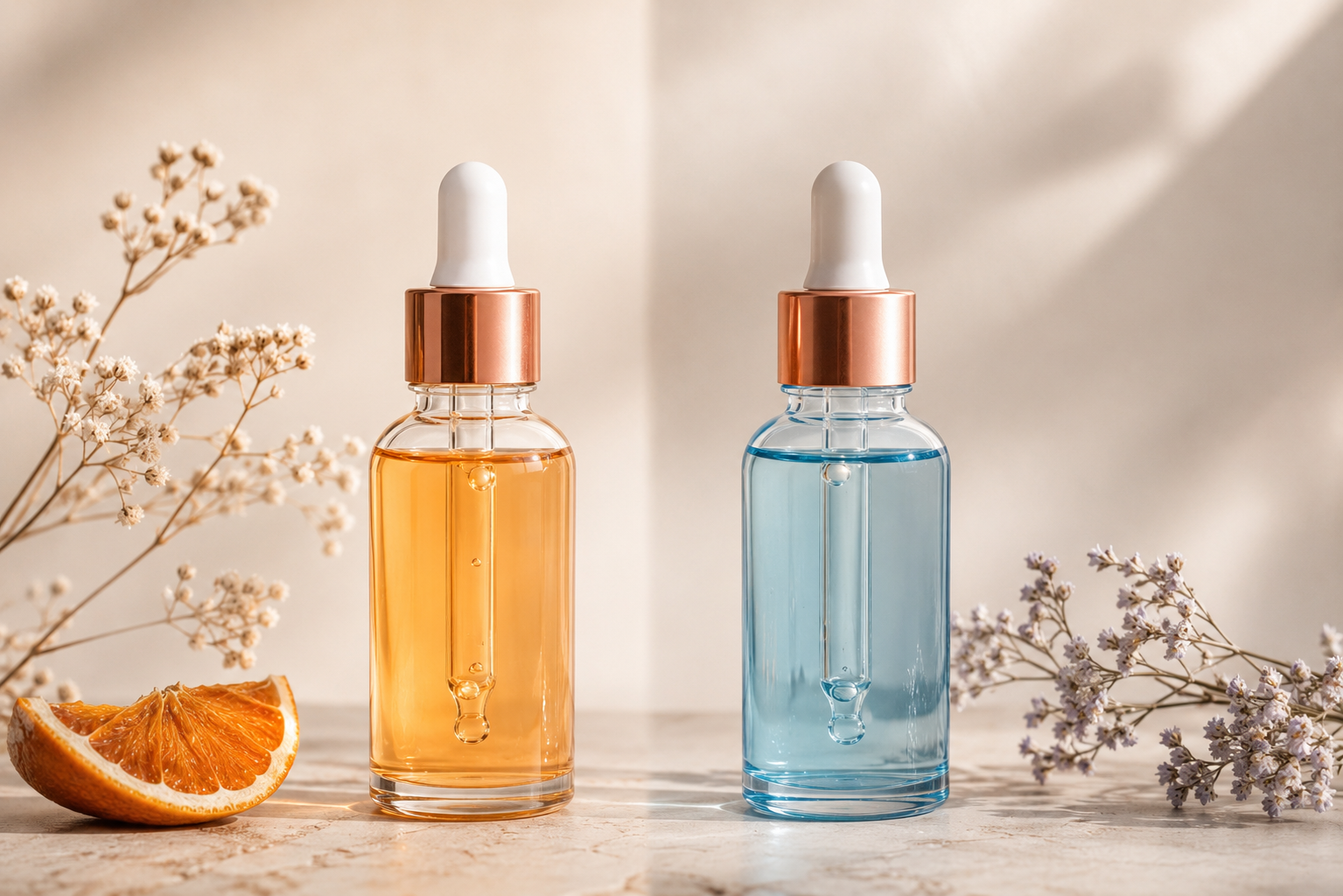
GHK-Cu vs vitamin C is one of the most debated comparisons in skincare right now — and for good reason. Vitamin C has been a staple of serious anti-ageing routines for decades, with an enormous body of clinical evidence behind it, found in everything from budget serums to £200 treatments. So when a 12-week clinical study found that GHK-Cu copper peptide outperformed vitamin C for collagen production — stimulating measurable collagen increase in 70% of participants versus 50% for vitamin C — it generated significant interest in skincare communities.
GHK-Cu vs Vitamin C: How Each Supports Collagen
Vitamin C (L-Ascorbic Acid)
Vitamin C supports collagen production as a co-factor in the hydroxylation of proline and lysine — two amino acids essential to stable collagen structure. Without adequate vitamin C, newly produced collagen cannot form properly: it lacks the structural stability needed to function as structural scaffolding. Vitamin C also acts as a potent antioxidant, neutralising free radicals that break down existing collagen. And it inhibits melanin production, which is why it’s particularly valued for brightening and addressing hyperpigmentation alongside its collagen-supporting role.
The most effective form of topical vitamin C — L-ascorbic acid — is also the most unstable. It oxidises quickly on exposure to light and air, turning orange/brown when degraded and losing efficacy. Formulating effective vitamin C products requires careful handling of pH, packaging and preserving systems. Effective vitamin C serums at meaningful concentrations (10–20% L-AA) can also be irritating, particularly on sensitive or compromised skin.
GHK-Cu
GHK-Cu supports collagen through a fundamentally different mechanism. Rather than providing a building block or co-factor, it acts as a direct signalling molecule — binding to fibroblast receptors and stimulating these cells to increase collagen synthesis. It also delivers bioavailable copper to lysyl oxidase, the enzyme that cross-links collagen fibres after production, supporting the structural quality of the collagen being made rather than just its quantity. Additionally, GHK-Cu supports elastin production alongside collagen, and provides antioxidant activity through upregulation of the body’s own antioxidant enzymes (superoxide dismutase) rather than providing exogenous antioxidant molecules like vitamin C does.
GHK-Cu is a stable, well-tolerated compound that does not degrade in the way L-ascorbic acid does, has a very low irritation profile, and can be applied morning or evening without the photosensitising considerations of some vitamin C formulations.
The Clinical Study: What It Actually Shows
The most-cited GHK-Cu vs vitamin C data comes from a controlled 12-week study comparing both ingredients directly against retinoic acid and placebo. The frequently cited study applied GHK-Cu cream, vitamin C cream and retinoic acid cream to thigh skin over 12 weeks, then assessed collagen production via skin biopsy. The results:
| Ingredient | % of Participants Showing Increased Collagen | Mechanism |
| GHK-Cu | 70% | Direct fibroblast signalling + copper delivery |
| Vitamin C | 50% | Collagen co-factor + antioxidant |
| Retinoic acid | 40% | Cell turnover acceleration |
| Placebo | Minimal | — |
This is one of the few head-to-head studies comparing these three gold-standard anti-ageing ingredients directly. The results have been independently referenced in multiple subsequent reviews and are considered methodologically sound.
It’s important to interpret this correctly. The study measured collagen increase specifically — not overall skin improvement across all metrics. Vitamin C’s antioxidant protection, brightening effects and melanin inhibition are not measured here. GHK-Cu “winning” for collagen production does not mean vitamin C is redundant — it means that for the specific goal of collagen stimulation, GHK-Cu demonstrated a stronger effect in this study cohort.
GHK-Cu vs Vitamin C: What Each Does Best
| Goal | Better Choice | Why |
| Collagen production | GHK-Cu | 70% vs 50% in head-to-head study; direct fibroblast signalling |
| Collagen quality / cross-linking | GHK-Cu | Copper delivery to lysyl oxidase — vitamin C doesn’t address this |
| Brightening / hyperpigmentation | Vitamin C | Melanin inhibition — GHK-Cu has no direct brightening effect |
| Antioxidant protection | Both — different mechanisms | Vitamin C: direct free radical scavenging. GHK-Cu: upregulates SOD/catalase |
| Tolerability on sensitive skin | GHK-Cu | L-ascorbic acid can irritate; GHK-Cu rarely does |
| Stability / shelf life | GHK-Cu | Vitamin C oxidises quickly; GHK-Cu is stable in lyophilised form |
| Elastin support | GHK-Cu | Same lysyl oxidase pathway also cross-links elastin |
| Barrier repair | GHK-Cu | Glycosaminoglycan support — vitamin C has no direct barrier effect |
| Anti-inflammatory | GHK-Cu | Documented TNF-alpha/IL-6 suppression |
Can You Use Both? Yes — Here’s How
For those weighing GHK-Cu vs vitamin C as an either/or choice, the good news is you don’t have to pick just one. GHK-Cu and vitamin C are not interchangeable — they complement each other. Used together in a well-structured routine, they address collagen support through multiple mechanisms simultaneously. The practical constraint is compatibility: L-ascorbic acid’s low pH (typically 2.5–3.5) can disrupt the copper-peptide bond if the two are applied in the same step. They should not be layered together or used simultaneously.
The most practical approach:
- Morning: Vitamin C serum (antioxidant protection and brightening benefit from daytime application, particularly in combination with SPF)
- Evening: GHK-Cu solution (structural collagen support, barrier repair, anti-inflammatory — works well overnight)
- Both get their optimal use window without interfering with each other
If you only use one: For sensitive or reactive skin, or for those prioritising collagen density and barrier health over brightening, GHK-Cu is the more accessible starting point. For those focused on pigmentation, sun damage and antioxidant protection alongside collagen support, vitamin C in the morning and GHK-Cu in the evening is the most comprehensive approach.
The Stability Advantage
One practical consideration that’s often underestimated: vitamin C’s instability means that an oxidised, ineffective serum is common. L-ascorbic acid products must be stored carefully, used within a relatively short period of opening, and show visible signs of degradation (orange/brown colour) when oxidised. GHK-Cu in lyophilised powder form — as supplied by ghkcu.uk — is inherently more stable before reconstitution, and the QR-verified Certificate of Analysis means you know the purity of what you’re applying before you open the vial. After reconstitution, the solution should be kept refrigerated and used within 4 weeks.
Price and Value
When comparing GHK-Cu vs vitamin C on cost, high-quality vitamin C serums typically run higher per month than a single GHK-Cu vial. High-quality vitamin C serums at meaningful concentrations (10%+ L-AA) typically cost £30–£80+ in the UK market. GHK-Cu from ghkcu.uk is independently lab-verified at 99%+ purity with a QR-authenticated COA — at a competitive price per vial that makes daily use sustainable without the stability concerns of pre-formulated L-ascorbic acid products.
The Verdict
GHK-Cu wins for collagen production specifically — the study data supports this clearly. Vitamin C wins for brightening, melanin inhibition and the particular antioxidant mechanism of direct free radical scavenging. Neither is redundant. For the most comprehensive approach to skin longevity, both have a place — applied at different times to avoid interaction. For those who can only choose one and their primary concern is structural skin quality, collagen density and tolerability, GHK-Cu makes a strong case as the first choice.
The collagen ingredient that outperformed vitamin C in a 12-week study.
GHK-Cu from ghkcu.uk — 99%+ purity, QR-verified Certificate of Analysis, free UK delivery. Built for daily use as your foundational collagen-support ingredient. → Shop at ghkcu.uk