
GHK-Cu Eye Area: 5 Proven Benefits for Crow’s Feet
- 9 Mins to read
- Skincare Science
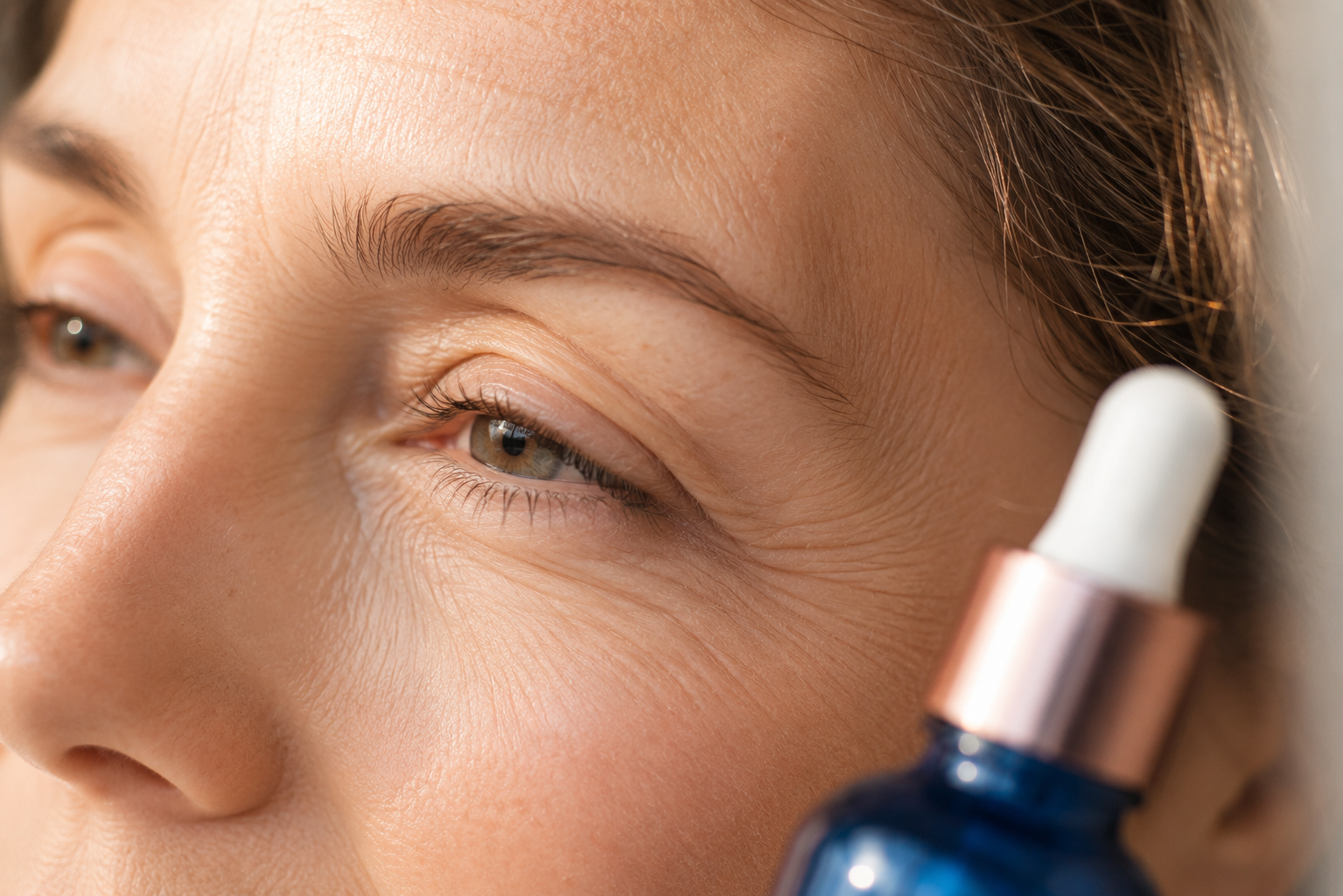
GHK-Cu eye area application is one of the most requested uses for this copper peptide — and for good reason. The skin around the eyes is the thinnest on the face, roughly 0.5mm compared to 2mm elsewhere, with less sebaceous gland activity, fewer supporting fat pads, and constant mechanical stress from blinking (approximately 10,000 blinks per day). It ages faster than any other area of the face, shows fatigue and dehydration more visibly, and is typically the first place people notice fine lines appearing.
GHK-Cu Eye Area: Why This Skin Ages Differently
Structural differences
The periorbital skin — the area surrounding the eye socket — is structurally different from skin elsewhere on the face. The dermis is thinner and has less collagen density to begin with. There is minimal subcutaneous fat directly beneath the skin in much of this area, meaning there’s less cushioning between the skin surface and the underlying muscle. As the skin’s collagen content declines with age, this lack of underlying support becomes more visible — fine lines from expression movement (crow’s feet, lines above the lid, under-eye creasing) deepen faster than equivalent lines on thicker skin elsewhere.
Mechanical stress
The orbicularis oculi — the muscle that surrounds the eye socket and controls blinking and squinting — creates constant repetitive movement in the overlying skin. Every blink, squint, smile and facial expression creates microfolding in the skin. In younger skin with good collagen density, this microfolding springs back completely. As collagen declines, it recovers less fully, and the repeated movement gradually deepens lines. This is the primary driver of crow’s feet and upper lid creasing, and it’s why this area shows age earlier than the cheek or forehead.
Fluid dynamics and puffiness
The loose connective tissue beneath the under-eye skin allows fluid to accumulate easily — this is the biological basis of under-eye puffiness and some degree of dark circles. The thinness of the skin also makes underlying blood vessels more visible, contributing to the purple-blue tones that many people experience. These are primarily vascular and structural issues rather than surface ones, which is why topical treatments for dark circles have limited efficacy — but barrier support and anti-inflammatory properties in this area can help reduce the appearance of puffiness and reactive redness over time.
How GHK-Cu Supports the Eye Area
Collagen support in the thinnest skin
The periorbital skin’s thinner collagen layer means it loses structural integrity faster than other areas — and it has more to gain from active collagen support. GHK-Cu’s signalling of fibroblasts to produce and organise collagen is directly relevant here: by supporting collagen density in an area that has less to begin with and loses it faster, GHK-Cu addresses one of the primary structural drivers of periorbital ageing. Published studies examining GHK-Cu for the eye area specifically include a controlled trial of 41 women with mild to advanced photoaged skin who applied GHK-Cu eye cream for 12 weeks, documenting reduced line depth and improved skin density — outcomes directly relevant to crow’s feet and under-eye creasing.
Tolerability — critical for the eye area
Many of the most effective cosmetic actives are poorly suited to periorbital use. Retinoids are often too irritating for the delicate eye skin, particularly in early use. High-concentration acids can cause stinging, milia or compromised barrier around the eyes. Vitamin C at therapeutic concentrations can be too harsh for the thin periorbital skin. GHK-Cu’s excellent tolerability profile — as a peptide naturally occurring in the body — makes it one of the most genuinely suitable active ingredients for consistent periorbital use. Irritation in this area is uncommon and mild when it does occur. This tolerability is exactly why GHK-Cu eye area use has become a common recommendation for those who’ve reacted to stronger actives.
Anti-inflammatory properties and puffiness
GHK-Cu’s anti-inflammatory activity — its documented influence on pro-inflammatory cytokines — may help reduce the persistent low-grade inflammation around the eyes that can contribute to puffiness and dark circles with a reddish-purple undertone. This is not a direct treatment for vascular dark circles (which are primarily a structural issue), but consistent anti-inflammatory support in the periorbital area can contribute to a calmer, less puffy appearance over time.
Barrier support for a low-sebum area
The periorbital area has very low sebaceous gland activity, meaning it has less natural lipid protection than the rest of the face. This makes it more prone to dryness and transepidermal water loss, which in turn makes fine lines look more prominent (dehydration exaggerates surface texture). GHK-Cu’s support for glycosaminoglycan production supports structural hydration in this low-sebum area, complementing a targeted eye moisturiser.
How to Apply GHK-Cu to the Eye Area: Step by Step
- Reconstitute as normal — add the mixing solution to the powder vial and swirl gently until fully dissolved.
- Apply to clean, dry skin — after cleansing and before any other serum layers. The periorbital skin absorbs actives most effectively when clean and dry.
- Use the ring finger — this finger naturally applies the lightest pressure, which is appropriate for the delicate periorbital skin. Avoid pulling or rubbing.
- Apply with a gentle tapping/dabbing motion — place small dots of solution around the orbital bone (along the brow bone and under-eye area) and tap gently until absorbed. Do not apply directly to the eyelid or the waterline.
- Allow to absorb fully — 1–2 minutes — before applying eye cream or moisturiser on top.
- Follow with a targeted eye moisturiser — the periorbital area benefits from a dedicated, richer eye cream or balm applied over the GHK-Cu to seal in moisture. Look for formulas with ceramides or peptides.
Important: Avoid direct contact with the eyes themselves. If solution enters the eye, rinse thoroughly with water. Do not apply to the eyelid crease or the inner corner where it could migrate to the eye surface. Keep the solution away from children.
GHK-Cu Eye Area: What Results to Expect
| Concern | Timeline | What To Expect |
| Under-eye dryness and fine lines | 2-4 weeks | Improved hydration, surface lines look softer |
| Crow’s feet | 6-12 weeks | Reduced depth with consistent collagen support |
| Puffiness | 2-6 weeks | Modest improvement from anti-inflammatory activity |
| Under-eye creasing | 8-12 weeks | Softer creasing as skin density improves |
| Dark circles (vascular) | Limited improvement | GHK-Cu is not a vascular treatment — structural improvement may help slightly |
| Overall skin quality in area | 6-10 weeks | Improved texture, tone and structural feel |
What GHK-Cu Won’t Do for the Eye Area
Being clear about GHK-Cu eye area limitations helps set realistic expectations from the start.
- It will not eliminate deep-set crow’s feet — significant expression lines require professional treatment (filler, toxin, resurfacing) for meaningful structural improvement
- It will not treat vascular dark circles — the purple-blue darkness caused by visible blood vessels beneath thin periorbital skin is a structural issue beyond topical ingredient reach
- It will not address hollowing — loss of the tear trough fat pad creates hollow dark circles that no topical ingredient addresses
- It will not produce overnight results — as with all GHK-Cu use, periorbital results develop over weeks and months of consistent use
Building a GHK-Cu Eye Area Routine
A practical daily approach for the periorbital area:
- Morning and evening: GHK-Cu solution applied with ring finger using light tapping motion, before other products
- Follow with: Eye cream or balm — ceramide-rich or peptide-containing formulas work well over GHK-Cu
- Morning SPF: Extend broad-spectrum SPF to cover the orbital area — UV is the single biggest driver of periorbital ageing and crow’s feet deepening
- Avoid in the same step: Retinol eye products, acid-containing eye creams — use on alternating evenings if using both
One vial, multiple areas: Many ghkcu.uk customers apply their GHK-Cu to the face, eye area and scalp in the same daily routine. Our 100mg vial provides ample product to cover all three areas consistently throughout the vial’s 4-week post-reconstitution use period.
The active ingredient your eye area actually needs.
GHK-Cu from ghkcu.uk — 99%+ purity, QR-verified Certificate of Analysis, free UK delivery. Gentle enough for daily periorbital use. Backed by published study data. → Shop at ghkcu.uk